“If Ragon’s erudition is immense, it has always been irrigated by the blood and misery of real life.”
— François Nourissier
By and copyright Michel Ragon
Translation copyright Paul Ben-Itzak
Reflecting the author’s popular roots, Michel Ragon’s 1956 “Trompe-l’oeil” is less an easy parody of the nascent contemporary art market than an introduction to the complex Abstract Art universe disguised as tragi-comic spoof, with contemporary swipes at corrupt art critics and mercenary art revues à la Balzac’s “Lost Illusions.” (It also offers a trenchant commentary on anti-Semitism.) Ragon’s colorful fictional personnages interact with some of the real-life artists of the era that he, as a critic and curator, championed (à la Zola). To read an excerpt of Michel Ragon’s “La Mémoire des vaincus” (The Book of the Vanquished), click here.
In the très chic Parisian salon of Monsieur Mumfy — the very same Mumfy of the celebrated underwear ads — “with Mumfy, you’re always comfy” — a Family Conference was underway. The plethora of Plexiglas and the multitude of apertures in the porous Oscar furniture eliminated any idea of intimacy in the vast square room, whose walls were ornamented with a collection of Klees. The quality of these paintings had earned their proprietor the high regard and hosannas, frequently expressed, of the leading art critics of Paris as well as art aficionados.
Ensconced in a tubular arm-chair held together with cream-colored cords which leant it the vague allure of a warped harp, Monsieur Mumfy was in the process of interrogating his son, standing before him. Slightly separated from them, but still participating in the conversation, Madame Mumfy was busy at a black ceramic table creating a more or less Cubist collage. It was not that Madame Mumfy was an artist, or even trying to pass as one, but that she liked to distract herself with cutting up colored paper and re-assembling it, sometimes à la Picasso, sometimes à la Matisse, just as 50 years earlier she might have devoted herself to needlework.
“My dear Charles,” Monsieur Mumfy declared, “it’s time to decide. You’ve now graduated from high school; it’s time to pick a career. We’re here to help….”
Charles, clad from head to toe in black, his stiff hair combed over his forehead à la Bourvil (or à la Marlon Brando), pulverizing his handkerchief between his nervous fingers, tentatively stepped forward before retreating, with a certain dandy-ness that might have lead one to suspect an inclination towards sexual inversion, but it was nothing like that. Charles’s effeminate affectations, like his bird-like hopping back and forth, his juvenile gestures, and the weaving of his hips when he walked, were à la mode.
“Respond, Cheri!” chimed in Madame Mumfy. “Don’t let your father just languish there. Otherwise we’re in for another 24 hours of stress!”
“Okay Pops, Moms,” Charles finally decided, accentuating his dandy-ness. “My dream is to become… a notary public.”
Madame Mumfy precipitously dropped her scissors and glue to rush to the side of her husband, who had begun to hyperventilate. Striking him on the back and tapping him on the cheeks, she tried to reassure him:
“It’s nothing, darling, nothing! Charles is obviously kidding….”
When Monsieur Mumfy had recovered his wits, his son, worried by the turn of events, repeated, all the same:
“I don’t want to make you mad Pops, Moms, but I’m not joking: I really want to be a notary public.”
Monsieur and Madame Mumfy glanced at each other with a complicit air tempered by indulgence. Then Monsieur Mumfy responded with a firm voice:
“My dear Charles, don’t be ridiculous. No one becomes a notary public these days. How could such an idea ever have sprouted up in the head of a MUMFY?! Choosing to be a notary public. The very idea! Does one choose to be a cuckold? Haven’t you read Balzac? Flaubert? For more than a hundred years notary publics have been looked at as grotesque characters, the butt of jokes — and your “dream” would be to sport a black skull-cap and bifocals with a pocket-watch hanging on a chain over a protuberant stomach that — thank God — you’re not even close to acquiring. Becoming a notary public might be fitting for the son of a country school-teacher, but you, Charles — do you want to be the shame of your family?
“Come, come now — it’s just the silly fancy of an adolescent. I’m going to help you…. I’ve got it! What if you became an artist…? A painter, for example?”
“But Pops, I don’t know how to paint.”
Monsieur Mumfy clutched his head between his hands in a sign of total exasperation in the face of such naïveté.
“Look at this blockhead! You’ll learn, Charles, you’ll learn! Does someone refuse to become a doctor because he’s never applied a bandage? One learns to paint, my boy, as with anything. And consider the future in painting. Picasso is a millionaire, as is Matisse…. Have you ever heard of a notary public who, starting out from scratch, has carved out such a shining success? Picasso lost so much time, in his youth, because he was poor, and couldn’t afford paints or canvasses, and didn’t know any dealers or critics. But you, Charles, won’t lack for anything. I’ll give you a monthly allowance so you won’t have anything to worry about. You can take advantage of my connections as a collector. With a little effort from you, my boy, we’ll make a famous artist out of you, who will be the pride and joy of the family. Look at Ancelin. He also wouldn’t have heard of becoming a painter. He wanted to be an officer, on the pretext that his father is a general. But General Ancelin talked him out of pursuing a career in a field compromised by the pacifism that’s more and more in vogue these days. He also, our old friend Ancelin, was able to see the opportunities available these days in the art world. And Ancelin now has a contract with Laivit-Canne’s gallery and will soon be exposed in New York.
Rising heavily, Monsieur Mumfy bumped his head against one of the blades of a Calder mobile rotating from the ceiling. He scooted it away distractedly with the back of his hand, as if it were a fly. The mobile started to undulate, with all its branches revolving in silence. It was as if a giant insect had suddenly come to life above the father and son, oblivious to its awakening. A soubrette entered, after knocking, apparently in the throes of panic.
“Madame, the pottery set that Monsieur gave Madame….”
“Yes…?
“I don’t know how it happened, but it’s… bleeding.”
“Now now, explain yourself clearly and don’t get upset,” sighed Madame Mumfy, delicately snipping a strip of embossed paper.
“Yes, Madame. I went to serve the consommé
in the pottery bowls and the consommé turned completely blue.”
“WHAT?!” erupted Monsieur Mumfy. “Who told you to touch that pottery?! You couldn’t tell that those plates were not made to be eaten from?!”
“Then what are they made for, Monsieur?” asked the maid, flustered.
“They’re not ‘made’ for anything!” roared Monsieur Mumfy even louder, so loud that the Calder began to hiccup. “Those plates are works of art. One does not eat from works of art. One beholds them!”
The maid tried to defend herself by babbling, “I wouldn’t have thought of pouring consommé on Monsieur’s paintings. I just thought that bowls are bowls….”
Monsieur and Madame Mumfy broke into simultaneous laughter, bursting out, “She believed that bowls were bowls…!” “Incredible!” “We must tell Paulhan about this!”
The maid departed, clearly vexed. By the immense bay window looking out over the Luxembourg Gardens, Charles, indifferent to the fit of laughter which had seized his parents, gazed nostalgically at the Law School.
***
Monsieur Mumfy was not a born art collector. Before the war, consumed as he was with his underwear factory, he didn’t even know that painters existed. It took an accident. One of his debtors brought him a batch of watercolors, gouaches, and paintings by an unknown German artist, pleading with him to accept the paintings as collateral. Monsieur Mumfy initially refused this singular arrangement. Since when did one trade underwear for paintings?! But the debtor had been driven to ruin. Ahead of taking him to court, Monsieur Mumfy had the paintings stored in one of his warehouses, without taking the trouble to even look at them. Some months later, the debtor committed suicide. Monsieur Mumfy had the paintings brought up so he could study them to see if by chance they might actually be worth something. Stupefied, he discovered that they were replete with child-like doodles — all sorts of rivers, of birds, of funny figures. He’d been had. He began to choke with rage. The bastard had conned him before offing himself! Just in case, though, he asked an art dealer to take a look; the dealer refused to buy anything, smiling snidely.
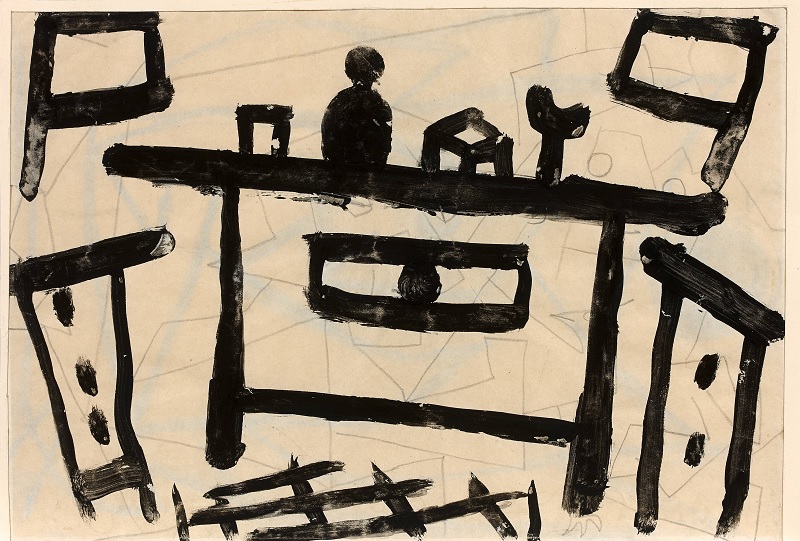 From the Arts Voyager archives: Paul Klee, Untitled, 1939. Image copyright and courtesy Artcurial.
“So I can throw them in the garbage,” Monsieur Mumfy fumed.
“Oh,” the dealer answered, with an evasive gesture, “hang on to them all the same. You never know. If you have the space….”
Immediately after the war, the very same dealer came back to see Monsieur Mumfy, who’d completely forgotten the painting fiasco. He offered him $5,000 for the whole lot of Klee works that he recalled seeing earlier.
Faced with the enormity of the amount (the debtor owed him, before the war, a little over $500), Monsieur Mumfy became suspicious, asked other dealers to come look at the paintings, and got offers of $7,500, $10,000, and $12,500 for the Klees…. He decided to read a few books about contemporary art, discovered that the market for paintings was the most speculative around, and that Klee was considered in America to be a major painter. He bought ornate frames for his paintings and had them hung in his salon. Before long, there were requests to photograph ‘his’ oeuvres, and to reproduce them in color in luxury magazines and art books. The name Mumfy was evoked wherever there was talk of Klee’s oeuvre. Thus he was catapulted, almost unconsciously, into the midst of the world of arts and letters and readily let himself be converted to all things avant-garde. He allowed himself to indulge in the luxury of philanthropy, underwriting several art revues and sponsoring young artists whose paintings resembled Klee’s. He was even recognized as one of the premiere Klee specialists in France. Far from making him lose money, the arts earned him notoriety he’d never even dreamed of as a simple garmento. He was decorated for services rendered to the arts. Famous artists cultivated his friendship. Even his fellow industrialists now showed him a deference that they’d never have dreamed of according him before he earned a reputation as an “influential collector.” Monsieur et Madame Michaud wanted to be up-to-date. They bought an apartment that they hired Le Corbusier to transform. Nothing, absolutely nothing in their home pre-dated the 20th century (with the possible exception of its proprietors).
Brought up amongst this architecture of pure lines, blasé about being surrounded by furniture which constantly reminded him of a dentist’s office, exhausted by this daily frequenting of chefs-d’oeuvre, Charles began to fantasize about living in a dusty bureau, with large old straight-legged wooden arm-chairs, an oak desk and an ink-well with a feather plume. This was his own form of poetry. To every teenager his folly.
*In English in the original.
Original French language text of excerpt, by Michel Ragon:
Dans le salon très moderne de Monsieur Michaud, le fameux Michaud des sous-vêtements du même nom (« avec Michaud, toujours chaud »), se tenait une réunion de famille. L’abondance du plexiglas et les multiples ouvertures des meubles Oscar enlevaient toute intimité à cette vaste salle cubique dont les murs s’ornaient d’une collection de peintures de Klee. Leur qualité valait à son propriétaire l’estime et la considération, très souvent exprimée, des meilleurs écrivains et amateurs d’art.
Assis dans un fauteuil tubulaire tendu de cordes blanches qui lui donnaient une vague allure de harpe faussée, Monsieur Michaud interrogeait son fils, debout devant lui. Un peu à l’écart, mais participant toutefois à la conversation, Madame Michaud s’occupait à un collage relativement cubiste sur une table de céramique noire. Non pas que Madame Michaud fût artiste, ni même qu’elle tentât de passer pour telle, mais elle se distrayait en découpant des morceaux de papiers de couleurs et en les assemblant, tantôt à la manière de Picasso, tantôt à la manière de Matisse, comme elle se fût donnée, cinquante ans plus tôt, aux points de canevas.
— Voyons, Charles, disait Monsieur Michaud à son fils, décide-toi. Tu viens d’être reçu a ton bac, il te faut t’orienter vers une carrière. Nous sommes là pour t’aider…
Charles, tout de noir vêtu, les cheveux raides ramenés sur le front à la Bourvil (ou à la Marlon Brando), triturait son mouchoir, avançait une jambe, la reculait, avec un dandinement pouvant faire supposer qu’il tendait à l’inversion sexuelle, mais il n’en était rien. L’allure efféminée de Charles, comme ses sautillements, ses gestes gamins, sa démarche déhanchée, appartenait au style de l’époque.
— Réponds, Amour, s’exclama Madame Michaud, ne laisse pas languir ton père ; sinon il va encore nous faire vingt-quatre de tension!
— Voila, pap’, mam’, se décida enfin Charles, en accentuant son dandinement, moi j’aimerais bien devenir notaire.
Madame Michaud abandonna précipitamment ses ciseaux et sa colle pour courir à son mari qui suffoquait. Elle le frappais dans le dos avec énergie, lui tapotait les joues :
— Ce n’est rien, darling*, ce n’est rien ! Charles plaisante, tu le vois bien…
Lorsque Monsieur Michaud reprit « ses esprits », Charles très ennuyé par la tournure des événements, redit quand même :
— Je ne voudrais pas vous fâcher, pap’, mam’, mais c’est vrai : j’aimerais bien être notaire.
Monsieur et Madame Michaud se regardèrent d’un air entendu et indulgent. Puis Monsieur Michaud dit d’une voix ferme :
— Mon petit Charles, tu es ridicule. On n’est plus notaire, de nos jours. Comment une pareille idée a-t-elle pu se nicher dans la tête du fils Michaud ! Choisir d’être notaire… Est-ce que l’on choisit d’être cocu ? Enfin, quoi, n’as-tu pas lu Balzac ? Flaubert ? Depuis cent ans les notaires sont des personnages de farce et ton idéal serait de coiffer la calotte noire, de porter des bésicles et une chaîne de montre en or sur un ventre que, Dieu merci, tu n’es pas encore près d’acquérir. Le métier de notaire peut, à la rigueur, convenir à un fils d’instituteur de campagne ; mais toi, Charles, veux-tu faire honte à ta famille ?
« Allons, allons, c’est une bêtise de jeune homme. Je vais t’aider, moi. Tiens… si tu faisais une carrière d’artiste… Peintre, par exemple ?
— Mais, pap’, je ne sais pas peindre…
Monsieur Michaud se prit le crâne à pleines mains, en signe de découragement total devant une telle innocence.
— Regardez-moi ce grand sot ! Mais tu apprendras, Charles ! Est-ce qu’on refuse d’envisager la médecine parce qu’on n’a jamais fait un pansement ! La peinture s’apprend, mon petit, comme toute chose. Et regarde l’avenir qui est offert à un peintre. Picasso est milliardaire, Matisse aussi… Connais-tu un notaire qui, parti de rien, soit arrivé à une aussi brillante situation ? Picasso a perdu beaucoup de temps, dans sa jeunesse, parce qu’il était pauvre, qu’il ne pouvait pas s’acheter de couleurs ni de toiles, qu’il n’avait aucune relation parmi les marchands et les critiques. Mais toi, tu ne manqueras de rien. Je te donnerai une mensualité qui te laissera la tête libre. Tu profiteras de mes relations de collectionneur. Allez, fiston, avec un pu de bonne volonté de ta part, nous ferons de toi un artiste célèbre, qui sera la joie de la famille. Regarde Ancelin, il ne voulais rien savoir pour être peintre, lui non plus. Il voulait devenir officier, sous prétexte que son père est général. Mais le général Ancelin a bien su le dissuader de suivre une carrière aussi compromise par ce pacifisme de plus en plus en vogue. Lui aussi, ce vieil ami Ancelin, avait su voir quels débouchés offrait maintenant le monde des arts. Ancelin a son contrat chez Laivit-Canne et il va bientôt exposer a New York.
En se relevant lourdement, Monsieur Michaud heurta du front une pale d’un mobile de Calder qui se balançait dans la pièce. Il la chassa distraitement du revers de la main, comme une mouche. Le mobile se mit à onduler, toutes les branches évoluèrent en silence. On eût dit qu’un gigantesque insecte se fût tout à coup éveillé au-dessus du père et du fils qui n’y prenaient garde. Une soubrette entre, après avoir frappé. Elle paraissait affolée :
— Madame, le service de céramique que Monsieur avait offert à Madame…
— Et bien ?
— Je ne sais pas comment cela a pu se produire, mais il déteint.
— Expliquez-vous clairement et ne vous énervez pas, soupira Madame Michaud en coupant délicatement une languette de papier gaufré.
— Oui, Madame, j’ai voulu servir le consommé dans le service en céramique et le consommé est devenu tout bleu.
— C’est insensé, hurla Monsieur Michaud. Qui vous a dit de toucher à ce service ! Vous n’avez donc pas vu que ces assiettes n’étaient pas faites pour manger dedans !
— Alors elle sont faites pour quoi, Monsieur, demanda la bonne, ahurie.
— Mais pour rien, hurla encore plus fort Monsieur Michaud, si fort que le Calder en eut des hoquets. Ces assiettes sont des œuvres d’art. On ne mange pas dans des œuvres d’art. On les regarde !
La bonne essaya de se justifier en bougonnant :
— Je n’aurais jamais pensé verser du consommé dans les tableaux de Monsieur. Mais je croyais que des assiettes étaient des assiettes…
Monsieur et Madame Michaud éclatèrent de rire en même temps. Ils pouffaient : « Elle croyait que les assiettes étaient des assiettes… C’est à ne pas croire ! Il faudra raconter ça a Paulhan. »
La bonne repartit, vexée. Par l’immense baie vitrée qui donnait sur le Jardin du Luxembourg, Charles, indifférent a la crise de fou rire de ses parents, regardait avec nostalgie vers la Faculté de Droit.
***
Monsieur Michaud n’était pas né collectionneur. Avant la guerre, tout occupé à son industrie de sous-vêtements, il ignorait même qu’il existait encore des peintres. Il avait fallu un hasard. Un de ses débiteurs lui apporta un lot d’aquarelles, de gouaches et de peintures d’un artiste allemand inconnu, en le suppliant de les conserver comme gage. Monsieur Michaud refusa d’abord ce singulier marché. Depuis quand échange-t-on des sous-vêtements contre de la peinture ! Mais le débiteur était acculé à la ruine. En attendant d’entamer des poursuites, Monsieur Michaud fit porter dans une de ses remises toutes ces peintures qu’il ne prit même pas la peine de regarder. Quelques mois plus tard, son débiteur se suicida. Monsieur Michaud se fit apporter les peintures afin d’examiner s’il pourrait en tirer quelque argent. Stupéfait, il vit qu’il s’agissait de choses enfantines, des sortes de fleuves, d’oiseaux, de bonshommes. Il s’était fait bien avoir. La fureur l’étranglait. Ce salaud de machin s’était payé sa tête avant de se suicider. A tout hasard, il fit quand même venir un marchand qui refusa d’acheter en souriant d’un air supérieur.
— Alors, je peux les foutre à la poubelle, suffoqua-t-il.
— Oh, dit le marchand, avec un geste évasif, gardez-les toujours. On ne sait jamais. Si vous avez de la place…
Peu après la guerre, ce même marchand revint voir Monsieur Michaud qui avait complètement oublié cette histoire de peintures. Il lui offrit deux millions pour ce lot d’œuvres de Klee qu’il se souvenait avoir vu autrefois.
Devant l’énormité de la somme (le débiteur ne lui devait, avant la guerre, que quelques centaines de mille francs), il se méfia, fit venir d’autres marchands de tableaux qui lui offrirent trois, quatre, cinq millions… Il se mit alors à lire quelques livres sur l’art contemporain, découvrit que la peinture était la marchandise la plus spéculative qui soit et que l’on considérait Klee, en Amérique, comme un grand peintre. Il fit encadrer luxueusement ses peintures et les accrocha dans son salon. Bientôt, on lui demanda l’autorisation de photographier « ses » œuvres, de les reproduire en couleurs dans des revues luxueuses et des livres d’art. Son nom fut mentionné à chaque fois que l’on parlait de l’œuvre de Klee. Il pénétra ainsi, à son insu, dans le monde des arts et des lettres et se laissa aisément convertir à toutes les avant-gardes. Il se paya le luxe d’être parfois philanthrope, de subventionner quelques revues, d’encourager quelques jeunes artistes dont la peinture ressemblait à celle de Klee. Il arriva même à passer pour l’un des premiers spécialistes de Klee en France. Loin de lui faire perdre de l’argent, les arts lui apportaient une considération qu’il n’avait jamais obtenue en tant qu’industriel. On le décora pour services rendus aux arts. Des artistes célèbres recherchèrent son amitié. Même les autres industriels lui témoignaient maintenant une déférence qu’ils n’auraient jamais eu l’idée de lui accorder avant qu’il devînt un « grand collectionneur ». Monsieur et Madame Michaud voulurent être à la page. Ils achetèrent un appartement qu’ils firent transformer par Le Corbusier. Rien, absolument rien chez eux, ne fut antérieur à ce siècle, si ce n’étaient eux-mêmes.
Elevé dans cette architecture aux lignes pures, blasé du mobilier qui lui rappelait fâcheusement le cabinet du dentiste, abruti par la fréquentation journalière des chefs-d’œuvre, Charles se prit à souhaiter vivre dans une étude poussiéreuse, avec de grandes vielles chaises aux pieds droits, en bois, avec un bureau en bois et un porte-plume avec une plume. C’était sa poésie, à lui. A chaque adolescent sa folie.
Excerpted from “Trompe-l’œil,” by Michel Ragon, published in 1956 by Éditions Albin Michel, Paris, and copyright Michel Ragon.
 The Paris Tribune