Le fond de l’air est rouge / Seeing red with Chris Marker, seeing film with Jonas Mekas

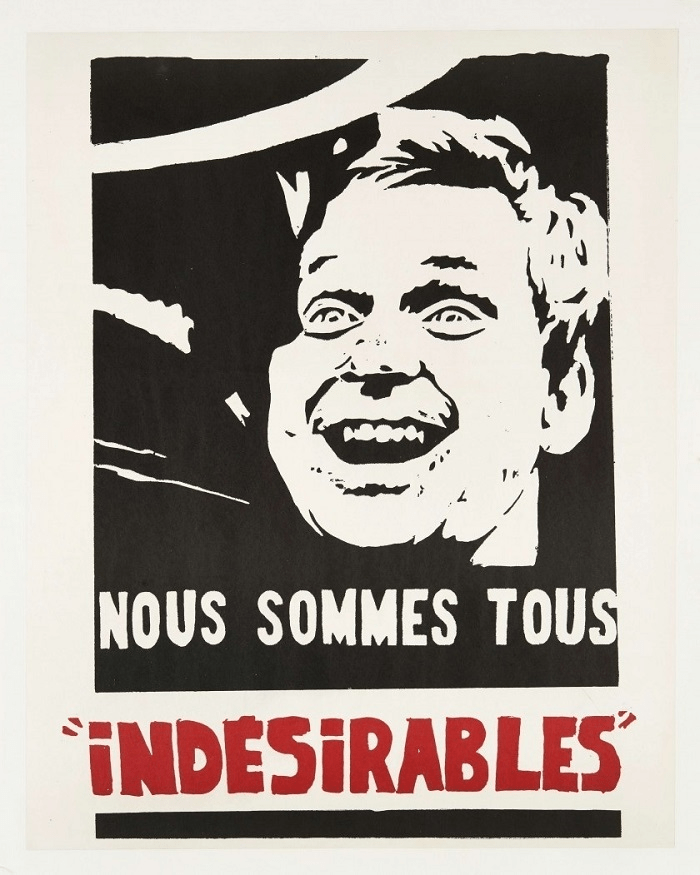
A poster from the May 1968 student and worker protests in Paris which takes as model student leader Daniel Cohn-Bendit, expelled from France as an ‘undesirable’ and later elected to the European parliament as a leader of the Green movement.

by Paul Ben-Itzak
Copyright 2021 Paul Ben-Itzak

First published on the Dance Insider & Arts Voyager on January 20, 2012 and newly edited for today’s publication.

After 15 years of following and reviewing the offerings of New York’s 40+ year-old Anthology Film Archives, easily the best and bravest cinematheque in the United States and one of the top in the world, I think I’m finally beginning to understand what Anthology artistic director Jonas Mekas (a determinedly idiosyncratic independent avant-garde filmmaker in his own right, and founding piston of the SoHo scene of the 1960s) and his colleagues are up to, or rather, how they’ve chosen to manifest it. Historically partial to fiction and less engaged by documentaries, at first I wasn’t particularly keen on the preponderance of the latter at Anthology. But after watching Chris Marker’s “Le fond de l’air est rouge” (cryptically translated as “Grin Without a Cat,” an allusion to Lewis Carroll’s Cheshire Cat) and Sergei Loznitsa’s “Revue” and “Blockade,” all screening in “The Compilation Film” series beginning today at Anthology, I understand that what Mekas and crew are primarily interested in is film that knows it’s film and that fully exploits the medium — and even expands it. Or to paraphrase Jean-Luc Godard’s imperative: One shouldn’t come away from a film feeling like the director simply set his camera before a stage, but that he used it like writer uses a pen.

Witness Marker’s film. Issued in 1978 and ‘re-actualized’ in 1993, “Le fond de l’air est rouge” (more literally translated as “The base of the air is red”) takes as its direct subject various liberation struggles and anti-War crusades of the ’60s and ’70s, many with post-World War II roots. And Marker’s conclusion might seem discouraging, even potentially paralyzing, particularly in the dawn of a new movement essentially founded on the same claim, a more just distribution of wealth: By Marker’s account, all these movements, or if you prefer, The Movement, eventually failed, often because of the faulty execution of the theology which was its fount, Communism. Che Guevara, we’re told in the film, seems to have finally understood that the real enemy was power, whether it called itself Capitalism or Socialism. The Soviet suppression of the Prague Spring of 1968 seems to have woken up Cuban leader Fidel Castro to the fact that Communism was not a de facto guarantor of Democracy, and could sometimes even menace it, as we see during poignant footage in which Castro wrestles in real time — while delivering a speech denouncing the Soviet Union’s sending tanks into Czechoslovakia — with the realization that he must condemn the Soviet invasion, even as he acknowledges that such criticism will play into the hands of “Imperialist” countries.

Perhaps most incredible, in the light of 2011, is a French Communist leader who finally allows, speaking in 1970, that the French Communist Party might just have to collaborate with other parties on the Left to defeat the bourgeoisie. The Communists barely broke 1 percent in the 2007 French presidential election, and in 2012’s they’re not even fielding their own candidate, preferring to back an ex-Socialist Party member. One person who seems to get it right in the film not too long after the events is Larry Bensky, the Pacifica Radio paragon and former Paris editor of the Paris Review, whose powers of analysis often have less lag time than most historians. Interviewed sometime in the 1970s, resplendent in John Lennon circa Abby Road long hair and beard, Bensky says that even though it may seem like there is less activism in the 1970s, today’s activists have already learned a lesson their ’60s predecessors didn’t, the necessity of working together with other groups. (Or what’s known today in 2021– and mocked in neo-Liberal French circles — as “intersectionality.” Une fois de plus, Larry, you nailed it avant l’heure) Even observing the weight Marker gives to French union leaders, both in direct interviews and in footage from demonstrations, is a jarring contrast with the present reality, when few private sector workers belong to unions and many union leaders seem more interested in securing their terrain than effectively advancing a worker-friendly agenda.

Add to the chronology of events covered by Marker the killing of Che, Watergate, the assassination of Chilean president Salvador Allende, and — if I understand his thesis correctly — the lack of any real legacy from France’s May 1968 student movement (although it is moving to see a young Daniel Cohn-Bendit, a.k.a. “Danny the Red,” hold forth in 1968 from the perspective of 2012, when he’s still an influential counter-balance to Capitalism-centric Euro-globalization, as co-president of the Green group in the EU Parliament), and Marker’s evident conclusion that it all whithered away with the disintegration of Communism, and the film might seem depressing… on the editorial level anyway.

Why, then, does “Le fond de l’air est rouge” leave one feeling optimistic?

What’s inspiring about this film — and makes it fit into the Anthology Film Archives mission, as I understand that mission — is how gorgeous, original, and genre-expanding it is as a film. (Marker was, after all, the director of the haunting futuristic photo-film “La jetée.”) To be honest, I was not up for yet another golden-aura’d ’60s re-cap. I even felt that having lived the era as a child growing up in San Francisco, I didn’t particularly need a refresher course and Marker wouldn’t teach me anything new. But with techniques including variously tinted sepia tones — brown, orange, red — as well as his skittish minimalist electronic score, the interweaving of end of WWII footage, film of demonstrations all over the world, direct interviews, speeches of the epoch seen on a television in a darkened room, and even a slow-motion scene from a Chinese propaganda ballet with a woman in red slowly pirouetting and being turned and lifted by a man, Marker has created a real work of art.

Marker has also brought perspective to this story, so that it’s not just a nostalgic replay of protest marches. The immediate perspective is Vietnam, and here Marker begins with harrowing footage that pre-dates WikiLeaks’s release of audio revealing American helicopters mowing down civilians and even a journalist: We see and hear American bombers dropping bombs and Napalm on Vietnam, with the narration provided by one of the pilots, who could not be more excited than to be dropping napalm on “Vietcong” and seeing them flee their trenches into the open. He might be exulting over fireworks at a 4th of July picnic.

The bigger context is of course how most of these movements fit in with the larger dream of Communism, and its gradual erosion. Here “Le fond de l’air est rouge,” discouraging as it may be as an obituary for the movements of the ’60s, offers a ray of hope from the ashes, if I can mix my metaphors: Cynics like to say that the Movement des Indignes, or “Occupy” movement as it’s called in the U.S., doesn’t know what it wants. But in fact it’s the movement’s very freedom from a specific dogma that may be its salvation. Dogmas can be anchors, but they can also be anvils.
Le Feuilleton (the Serial), 6: Exclusive! “Trompe-l’Oeil,” Michel Ragon’s saga of art, artists, dealers, anti-Semitism, and critics in Post-war Paris, Part 6

by and copyright Michel Ragon
Translation copyright Paul Ben-Itzak
From “Trompe-l’oeil,” published in 1956 by Éditions Albin Michel

Part six in the Paris Tribune’s exclusive English-language translation of Michel Ragon’s seminal 1956 novel taking on the world of abstract art, artists, art collectors, art dealers, and art critics in Paris, as well as post-War anti-Semitism in France. For the first five parts, click here. Translator Paul Ben-Itzak is looking to rent digs in Paris this Spring and for the Fall. Paul Ben-Itzak cherche un sous-loc à Paris pour le printemps. Got a tip? Tuyau? E-mail him at artsvoyager@gmail.com .

Summer had scattered the artists. The poorest remained in a Paris deserted and torrid. The better off found themselves on the Cote d’Azur, where they automatically took up the rhythm of their Parisian lives: gallery visits, squabbles between critics, internecine rivalries between dealers, interminable palaver in the cafés which supplanted le Select or le Dôme, the dazzling vista of the Mediterranean replacing the buzzing of the boulevard Montparnasse.

At the end of September, they all returned to the nest, excited by the prospect of an exhibition to prepare, an article to write, a sale practically assured. Optimism was the order of the day. Would this be the great decisive year? Everyone had the right to hope so.

Returning first, Fontenoy frequently passed by Manhès’s atelier before finally finding him at home. He was impatient to reunite with his friend; he’d saved up so many things he wanted to share with him!

He knew the majority of the habitants of the cité, a kind of housing project allocated to artists.* From the moment he entered the narrow street, a tremor of robust howling indicated that Corato was reciting the aria from “Pagliati.” Corato was one of the poorest of the abstract painters. His somewhat obscure style, extremely nuanced, attracted few fans. No dealer was interested in him. An Italian, he took advantage of the pristine tenor’s voice with which nature had bestowed him by earning his living singing operatic airs in a café-concert. But this double-life took its toll. For that matter, his tenor’s day job made it hard for his fellow painters and the critics to take him seriously. One of them had even quipped, “Corato is a professional tenor. Painting is to him like the violin is to Ingres.” Certain barbs launched for the pleasure of coming up with a witty turn of phrase can also poison the victim’s existence. This particular one really wounded Corato. When Fontenoy knocked on the door of his atelier, the tenor-painter was discomfited to see him. “You know of course that I only sing because…”

“What new paintings do you have to show me?” Fontenoy cut him off.

If he wasn’t very enthusiastic about Corato’s art, he recognized the quality of his painting, the sincerity underlying it. At times the colors revealed a contained vibration which enabled Fontenoy to get a hint of what Corato’s painting might be if it was allowed to ripen. But Corato was 50 years old. Would fatigue finish him off before he’d be able to complete his experiments and find his style?

Fontenoy carefully studied Corato’s paintings in this atelier whose walls were plastered with travel posters. He told himself that these paintings were by far superior to so many others which made a mint. How was it possible that nobody had remarked their importance? He promised himself to write about Corato for L’Artiste.

Leaving Corato’s atelier, Fontenoy hailed the aged sculptor Morini, perched on his porch in a white blouse.

After a life of misery, Morini had suddenly achieved celebrity at the age of 80. Unexpectedly very rich, he continued living in his Spartan studio, alone as he’d been all his life, altering absolute nothing in his daily routine.

“Bonjour, Monsieur Morini,” Fontenoy greeted him. “You didn’t go away on vacation?”

“Bou… bou…,” grumbled the old man. “Vacation…? I’m quite happy chez moi.”

As he seemed notably sad, Fontenoy tried to flatter him.

“It’s formidable, Monsieur Morini! Life magazine devoted three pages, in color, to you.”

“Harrumph! That would have made my poor mother happy. If she hadn’t been dead for many years now. Like all of those who would have been happy to see such an article.”

“Well,” replied Fontenoy, embarrassed, “it might have taken a while, but now that you’ve been recognized, the recognition has been hundredfold.”

The old sculptor began furiously gesticulating. He yelled: “What the hell do I care, for all their greenbacks? I can’t even eat cake. All my teeth are gone.”

This eruption brought Manhès out of his atelier.

“You’re here!”

Isabel emerged in her turn, little Moussia clinging to her dress.

Fontenoy dashed into his friend’s atelier.

“And Blanche?”

“She’s getting ready for her exhibition. We spent our vacation together on the banks of the Loire.”

“So… it’s working out then?” Manhès asked, smiling broadly.

“Yes. We get along well. She’s a quite a chic girl. There’s no reason that it shouldn’t last.”

“For me, it’s never been so good. I sold well on the Cote d’Azur and since coming back I already have enough orders to last me until the Spring. Oh, that old fart Lévy-Kahn is sure going to be sorry for his little temper-tantrum.”

“Is Ancelin back in Paris?”

“No. He’s once again let himself be shanghaied by an old widow who swept him away to New York. You know him, he never loses an opportunity to cultivate his image. Meanwhile, Mumfy’s son has enrolled in the Academy of Abstract Art. Voila a new colleague on the horizon. His old man must have calculated that it would be cheaper to have abstract tableaux fabricated by his own offspring than to keep on buying them from actual artists. I saw the family the other day, to talk to them about Blanche’s water-colors. I think she might be able to sell them a few. But Mama Mumfy told me, in plugging her son: ‘I’m not going to show you what he’s done yet. It’s not quite at a fully developed level. But he’s so sincere!’

“I responded to her with Degas’s famous quip: ‘So young, and already sincere. Madame, I’m afraid your son is already a lost cause.’ She didn’t seem very happy with this summary verdict.”

Someone knocked on the door. Isabelle went to open it. A 40ish man, elegant with slicked-back hair, entered the room and began inspecting it.

“What do you want, Monsieur Androclès?” asked Manhès, without any finesse.

“I’ve come to offer you a deal.”

“I don’t cultivate vegetables here,” Manhès exclaimed, suddenly seized with a rage that Fontenoy could not understand.

“Oh, Manhès!” shot back the man, aggrieved, “you’ll rue the day you made that bad joke.”

He departed, taking his time.

A profound silence descended on the atelier. Isabelle finally broke it.

“Perhaps you shouldn’t have snubbed him like that. You’ve just made another enemy.”

“The only ones who don’t have any enemies are the mediocrities!”

Androclès was one of the most important art dealers in Paris. He’d made his fortune during the Occupation, by selling fresh fruit and vegetables. A shrewd broker had convinced him that the most fructuous way to invest his money was to buy paintings. He’d resisted such a patently idiotic idea for a long time. But the broker found an argument with weight: “If you buy a boat,” he explained, “you’ll need to hire a crew to take care of it, and there will always be repairs that need to be made. The more you take to sea, the more it will deteriorate. Same thing for a building. You’ll need a super, a concierge. One day the roof will cave in. Then the basement will flood. A car wears down every time you drive it. Everything deteriorates, everything has personnel and maintenance costs — except painting. You can still buy a Cezanne for the price of a building. You won’t have to do anything to maintain it, and its price can only go up.”

Like Mumfy, Androclès investigated and before long he too had contracted the virus. He had the flair to acquire second-tier Impressionists at low prices and third-tier Cubists that no one wanted. Today, these Impressionists and these Cubists had finally attained their petite glory in the retrospectives and they constituted the Androclès gallery’s capital. Then this genius stumbled upon an aged Cubist painter of the variety one just doesn’t see anymore. The painter in question, simultaneously naive and sage, had been living in retirement in the country, getting by on a small income furnished by a group of loyal American collectors. During the war, he lost this clientele and plunged into such misery, such oblivion, that his wife did not survive. How on Earth Androclès, this vegetable hawker who was completely ignorant of painting, had managed to learn of his existence was a complete mystery. It’s said that even drunks have a guardian angel. It’s quite possible. But what is certain is that there must be one for philistines. This guardian angel conducted Androclès to the home of the old abandoned Cubist. He arrived with his arms loaded with vittles and departed with them loaded with canvasses. Then he bided his time. When the vegetable hawker calculated that the old man must be out of provisions, he arrived like the man from Providence with a baked ham, swept up every scrap of art which still lingered in the atelier, at 50 francs the yard, and saw himself once more hailed as a benefactor. On these raids, the old painter would scout around for a gift to offer to the dealer. He’d then give him the original edition of a book by Apollinaire which he’d illustrated in his youth, or an old drawing.

After the Liberation, the old Cubist painter died just as he was being rehabilitated. The first successful exhibition at the Androclès gallery was constituted by some of these canvasses bartered for vittles. They were bought up at fantastic prices. Today, any museum which didn’t own at least one of these masterpieces was one embarrassed museum.

Androclès no longer hawked fruits and vegetables, but his wife, a fat babushka with a vulgar voice, regaled painting collectors with her ignorance.

Fontenoy recounted to Manhès: “One day, I found myself in the gallery. A visitor asked the price of a Picasso ‘collage.’ Mama Androclès was manning the boutique. ‘Ah, that one, Mister, it’s worth the big bucks. But it’s old. Look at the paper, it’s already yellowing.'”

“You know the one,” Manhès countered, “about the guy who came to ask Androclès for Van Gogh’s address, don’t you? He didn’t bat an eye. He simply declared, in a dignified tone, ‘That gentleman is not one of my painters.'”

Moussia ran over and grasped her father’s knees. Manhès swept the child up and dangled her from his hands. The little girl giggled.

“This makes up for all of it, Fontenoy. When you have the time, you should fabricate one of these little marvels of your own with Blanche!”

Fontenoy protested: “Lay off! You used to marry me off to every single girl we met. Now that I’m with Blanche, you want us to have a kid. But what can we do? I’d tell you that an artist isn’t made to have kids, but it would only piss you off.”

“What, you don’t like our little Moussia?”

“Sure I do, she’s a darling. But just because I like something I see chez les autres doesn’t mean I want to have it chez moi.

“Ah! And now,” announced Manhès in affectionately nudging the tot away, “now go play. Papa needs to work….(and he added, emphatically) I tell you, Fontenoy, between the wife and the kid…!”


*Originally applied to housing complexes constructed for workers, today the term ‘cité’ most often refers to housing projects in the poorer neighborhoods or border suburbs of French cities. Before the expansion of the Montparnasse train station in the 1950s which leveled them, the 13th, 14th, and 15th arrondissements of Paris housed many of the cités reserved for artists. (When the translator lived in the Cité Falguière in the 15th in 2000, the former atelier of Chaim Soutine was still visible at the entrance.) Michel Ragon notably wrote about a visit to the sculptor Brancusi’s atelier before it in turn was re-located, intact, to another part of the city… to make way for progress. (Translator’s note.)

LE FEUILLETON (THE SERIAL), 5: EXCLUSIVE! “TROMPE-L’OEIL,” MICHEL RAGON’S SAGA OF ART, ARTISTS, DEALERS, MARKETS, ANTI-SEMITISM, & CRITICS IN PARIS IN THE ’50S, Part 5

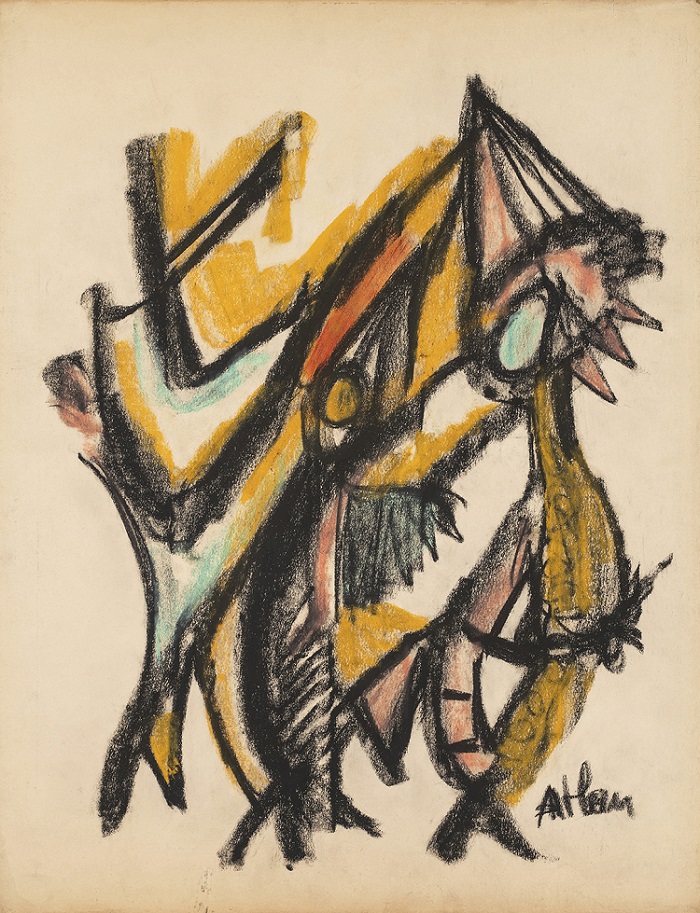
Jean-Michel Atlan, Sans Titre, 1949, pastel sur papier, 65 x 50,5 cm, smallOften lost among the quarrel between the Abstracts and the Figuratives of the 1950s (and the critical partisans of their schools) was the achievement of work which — sometimes depending on the eye of the viewer — traversed both terrains. Thus it is no surprise that for an exhibition which by its name alone, Animal Totem, promises a degree of concreteness, the Galerie Jeanne Bucher Jaeger has rolled out some of the Abstract movement’s most accomplished exponents, including Paul Reybeyrolle , André Masson, Maria Helena Vieira da Silva, and — in his Bucher Jaeger debut — Jean-Marie Atlan. To read more about Atlan from his leading critical advocate Michel Ragon, in exclusive English translation, click here. And about his epoch, see the latest episode of the Paris Tribune’s exclusive serialized English translation of Ragon’s 1956 novel “Trompe-l’oeil,” below. Animal Totem continues through March 14 at the Galerie Jeanne Bucher Jaeger’s Saint-Germain-des-Près space. Image courtesy Jeanne Bucher Jaeger, Paris. Translator Paul Ben-Itzak is looking to rent digs in Paris this Spring and for the Fall. Paul Ben-Itzak cherche un sous-loc à Paris pour le printemps. Got a tip? Tuyau? E-mail him at artsvoyager@gmail.com .
by and copyright Michel Ragon
Translation copyright Paul Ben-Itzak
From “Trompe-l’oeil,” published in 1956 by Éditions Albin Michel

Part five in the Paris Tribune’s exclusive English-language translation of Michel Ragon’s seminal 1956 novel taking on the world of abstract art, artists, art collectors, art dealers, and art critics in Paris, as well as post-War anti-Semitism in France. For the first four parts, click here.

The following Sunday, Fontenoy dropped in at Mustafa’s for an afternoon that began with stupor and concluded with a sickening feeling which owed less to the abundance of the patisseries than to the ambiance of this particular reception.

To start with, wandering around the various rooms of this estate surrounded by a sumptuous park in the well-to-do Paris suburb of Enghien, Fontenoy was very embarrassed to run into colleagues from the mainstream press whom he’d often described, in his articles for the avant-garde revues, as “trend-chasers.” Then there was the high-society crowd that he was so unfamiliar with. He knew everyone in the small world which gravitated around abstract painters, but here he was entering the world of those who had definitely arrived.

What also disconcerted him was that this villa bore no resemblance to Mustafa, who’d christened it “My Dear Beatrice.” It seemed, on the contrary, to have more to do with Beatrice Morose, the painter’s wife and a painter herself. The woman in question, a veritable queen for a day, promenaded five poodles yapping like canine chatterboxes among the guests. Voluminous and draped in velvet like an empress, Beatrice Morose showed off with a flippant gesture her own paintings, nudged in between admirable Mustafas.

She played the role of the guardian angel of this sorry drunkard who used to be Mustafa, and whom she’d now resurrected.

Everyone raved about the Master, his genius, the perennial legends of canvasses purchased for 300 francs which now sold for a million. But where was Mustafa? Fontenoy slunk from one room to another, hoping to run into him. Finally he ended up in a small deserted salon where he observed, from behind, an old man in a dinner-jacket trying to pry open a shuttered piano lid with a paper-cutter. At that very instant, a servant in full livery, built like an athlete, burst into the room, tore the instrument from the old man’s hands and dragged him away by force by gripping his fists.

The servant did not notice Fontenoy, who had scotched himself against a tapestry, but the old man looked at him as they strode by with an expression of such anguish, such desperation, that Fontenoy would remain shaken up for weeks. He’d recognized the man as Mustafa. The painter, for his part, appeared neither more nor less surprised to see a stranger hidden in his salon than if he’d just found the Count of Monte Cristo installed at his dining table.

Fontenoy trailed the servant, who dragged Mustafa along like a prisoner. They arrived in the main room, where the reception was being held. Only then did the servant let go of his master, respectfully guiding him among the guests, lightly hanging on to him by the arm.

“And now,” announced Beatrice Morose, “the Master will receive in his atelier.”

A satisfied murmur ran through the assembly. There was just one discordant rattling: Mustafa, begging for a drink. His bodyguard brought him a glass of water tinted with a splash of red wine. Amongst this crowd in the process of elegantly liquidating hundreds of bottles of champagne, Mustafa was the only one who did not have the right to drink.

The bodyguard-servant hauled the artist to the atelier, situated in the middle of the park. He placed a long, fine paint-brush in one hand, and a palette in the other. Then he gently nudged him towards the virgin canvas attached to an easel, crushed some colors on the palette, and retreated.

“Behold,” announced Beatrice Morose to her guests, “the Master is now going to paint. Let us leave him. And let us not intrude on this moment of inspired genius.”

Fontenoy had seen enough. He fled rather than left “My Dear Beatrice.”

****

Fontenoy might well tell himself that Mustafa’s case was a bad example, he nonetheless remained bitter contemplating the vanity of these “great successes.” Mustafa, lavished with honors and money, grown into a respectable and respected personage — and living in constant terror of his bodyguard. Forced to keep up the facade of naiveté, of health. Fontenoy shivered when he flashed back to that look of a hunted animal.

Granted, Mustafa was a sick man whom Beatrice Morose took care of, protecting as best she could, but Matisse…. Fontenoy recalled his first reportage at the great Fauve master’s studio. He still had trouble getting it into his head that an authentic artist could also be a bourgeoisie, and that a bourgeoisie could also be an artist. He still cleaved to a Montparnasian romanticism of which Manhès, along with Atlan and a rare handful of others, was among the last remaining examples. He loved this ambiance of the Montparnasse artist cafés, but the fact was that the true creators were rare among all the regulars of le Sélect or le Dôme. The vast majority of the habitués consisted of expatriates who were more or less painters, more or less poets, more or less failures or unknowns. If Modigliani had only eluded Death, Fontenoy thought, maybe he too would today be a bourgeoisie like Matisse, who numbered the most insignificant of his drawings and had his secretary classify them, who locked his paintings up in a bank vault after having them photographed. Or perhaps, to ensure that every day he produced his painting already paid for in advance, and that he stopped drinking, they might have made him into a decorated and glorious recluse, like they’d done to Mustafa. Soutine himself, during his final years, had turned into a fearful petite bourgeoisie, who, rumor had it, locked his mistress in every time he went to see his dealer out of fear that someone would steal her.

Would the same thing happen to Manhès? At the very thought of this, Fontenoy was ready to chuck it all and just write poems. But he couldn’t help himself. Painting was like a virus implanted in his blood.

Fontenoy saw no sign of Manhès at le Select. Isabelle and Moussia must have returned from the country. On the other hand, Blanche Favard was there, sitting alone at a table. He went to sit down next to her.

Fontenoy was happy to find someone to whom he could unburden himself about his visit to Mustafa’s. All it took was a little event like this to set off a moral crisis which would keep him from writing a single word for several days. Then he’d wander along the boulevard Montparnasse to the boulevard Saint-Germain, desperately seeking someone to talk to. Inevitably, it was at these very moments that his closest friends were nowhere to be found, not because they were trying to avoid him, but because a sort of curse made sure that the individual was left alone to confront his suffering. One of his poet friends, Ilarie Voronca, undergoing a similar crisis one evening, went knocking from door to door, hoping to find someone to save him from his somber ideas. No one was available and Ilarie Voronca was found several days later at home, where he’d turned the gas on and killed himself. He always thought about Ilarie Voronca whenever someone confided, “I’m really not doing well today. Can we spend the evening together? I just need a presence….” Sometimes he had an article to finish and wasn’t thrilled to play the role of confidant. But then he’d tell himself: “If Ilarie Voronca had been able to find one of us that night, he’d still be alive.”

Talking with Blanche Favard, an anguish which became stronger and stronger seized Fontenoy by the throat. He told himself: “I can’t go home alone tonight. It’s not possible. Too bad, if Blanche wants me, I’ll go home with her.” Then the leering face of Arlov loomed before him: “Why did Blanche have to ask me to organize an exhibition for her? People will say that I’m no better than Arlov.”

They left le Select in the wee hours, weaving along the boulevard Montparnasse. Blanche looped her elbow into the crook of Fontenoy’s arm. They headed towards the Cité Falguière*.

*Where Soutine himself once had an atelier. And where the translator once lived. (Translator’s Note.)

Lutèce Diary, 39: August 31, 1944 –Critique of the New Press / Critique de la nouvelle presse (French original follows English translation)

by Albert Camus
Translated by Paul Ben-Itzak

First published in the August 31, 1944 edition of Combat, the heretofore underground newspaper edited by Albert Camus. To read our English translation of Jean-Paul Sartre’s dispatch from the same issue of Combat, click here. To read our review with extracts of the recently published correspondence of Albert Camus’s correspondence with Maria Casarès, click here. After returning to Paris with false identity papers furnished by the Resistance, Albert Camus was the underground newspaper Combat’s final editor under the Occupation, on one occasion (as documented by Olivier Todd in his 1996 biography for Gallimard) being saved from being busted with proofs of the newspaper in his pocket at a Gestapo checkpoint when he was able to deftly pass the proofs to Casarès, correctly guessing that she would not be searched.

PARIS — Because between the insurrection and the war, a respite has today been granted us, I’d like to talk about a subject that I know well and which is dear to my heart: the Press. And because it’s a question of this new Press which has emerged from the battle of Paris, I’d like to speak with, at the same time, the fraternity and the clairvoyance one owes to comrades in combat. To read the entire article, in the original French and in its English translation, on our sister site the Maison de Traduction, click here.

Rentrée scolaire / Back to school in Paris et New York avec Matisse et Fénéon

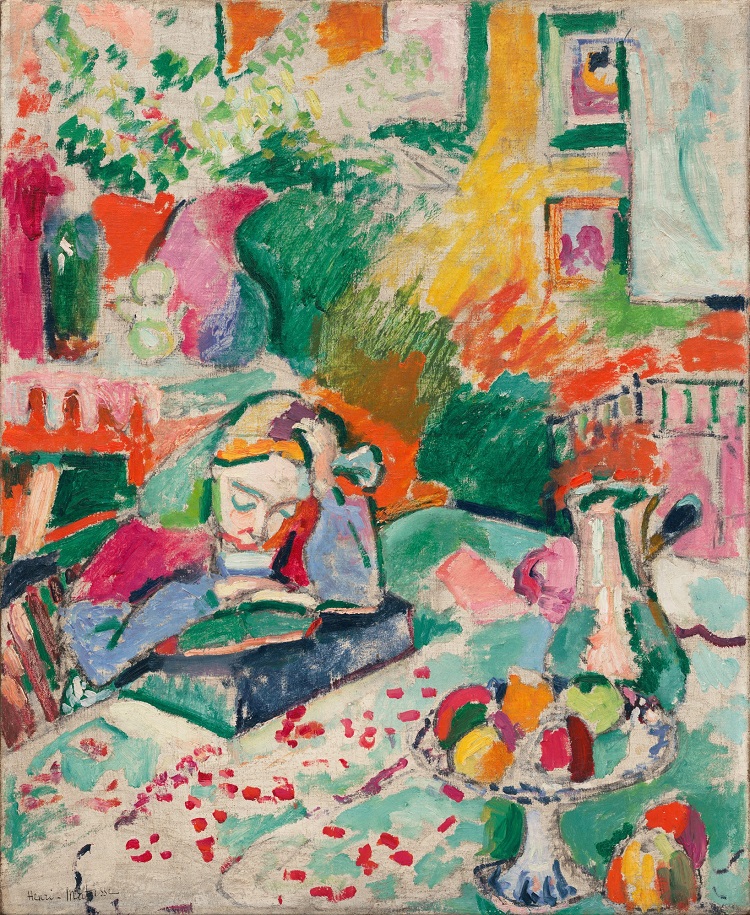
matisse young girl reading moma and orsay smallWhen an Anarchist meets the Avant-Garde in Paris et NY: From the exhibition Félix Fénéon: The Anarchist and the Avant-Garde — From Signac to Matisse and Beyond, running October 16 through January 27 at the Orangerie in Paris (in a slightly neutered title:  Les temps nouveaux, de Seurat à Matisse) and March 22 through July 25, 2020 at the Museum of Modern Art in New York: Henri Matisse, “Interior with a Young Girl (Girl Reading),” Paris 1905–06. Oil on canvas, 28 5/8 x 23 1/2″ (72.7 x 59.7 cm). The Museum of Modern Art, New York. Gift of Mr. and Mrs. David Rockefeller, 1991. Photo by Paige Knight. © 2019 Succession H. Matisse / Artists Rights Society (ARS), New York.
Vivre Villeglé! (And his lacerated sirens)

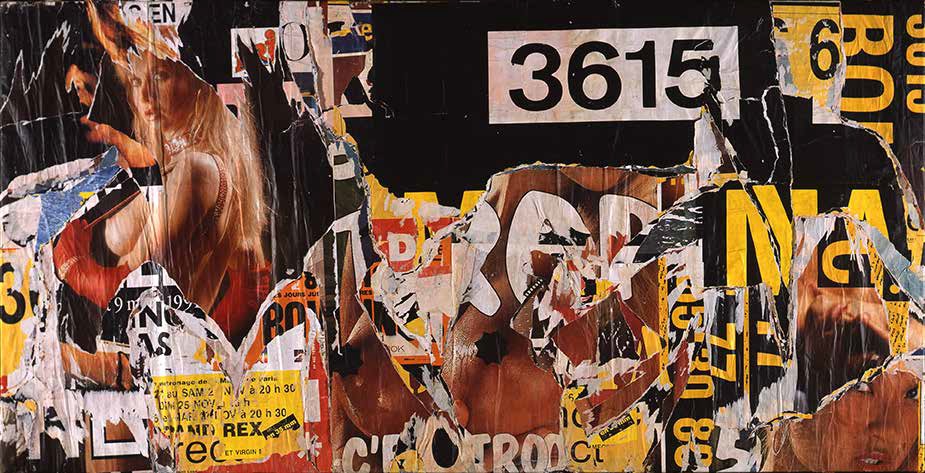
villegle breasty hottieIt’s fitting that Jacques Villeglé — like the pioneer in the art of the lacerated street poster (and the modern French detective novel) Léo Malet in the 1930s, an inveterate street-walker — realized his final work in removing and re-constituting the posters for erotic “message boxes” on the Mintel (the French ancestor of the Internet) that began plastering the rues of Paris between 1989 and 1992, when posters became largely supplanted by billboards. “There’s a certain affinity between the artist and these modern Lorettes,” Harry Bellet writes for the catalog of the works’ exhibition, running through April 12 at the gallery Vallois in Paris. “Like (the subjects of the posters), he walked the streets…. He also has an admirable respect for them: They display themselves — or rather they’re plastered up. He unglues them, liberates them…. Sometimes he tears them up, certainly, but as he confided to Nicolas Bourriaud…, ‘A wounded visage is still beautiful.’ In fact, Villeglé hasn’t lacerated these women; he’s softly, tenderly, langorously but always lovingly blown the leaves away.” Above: Jacques Villeglé, “Route de Vaugirard, Bas-Meudon, April 1991,” 1991. Lacerated poster mounted on canvas, 152 x 300 cm. Copyright Jacques Villeglé and courtesy Galerie Vallois.
The Lutèce Diaries, 19: “L’amour en fuite” or, As Romeo’s teeth bleed, love leaks out

by Paul Ben-Itzak
Copyright 20019 Paul Ben-Itzak

Written Monday, February 18. Re-written February 25 and dedicated to Pamela and Sabine in memory des belles moments passé autour de la rue des Martyrs. And to Emmanuelle Pretot, camarade en tout choses Truffaut. Like what you’re reading? Please let us know by making a donation so that we can continue this work. Please designate your PayPal donation in dollars or Euros to paulenitzak@gmail.com , or write us at that address to learn how to donate by check. If we bring in $120 we can continue to mend our bleeding heart with a boxed set of the complete works of François Truffaut. To read this article entirely in French or any other language, just click the translation button at the right.

PARIS — So there I was at dusk, heart broken and sentiments seeping out, teeth throbbing and gums bleeding profusely into a bandage I was trying in vain to grit (hard to grit when half your teeth are gone), staggering up the rue des Martyrs towards the Montmartre cemetery and the grave of the man I blamed it all on: François Truffaut.

In the late French director’s five-film, 20-year saga that began with the 1959 “The 400 Blows” and climaxed with “L’amour en fuite” (often mistranslated as “Love on the Run”; “Love Escapes” or “Love is leaking” are more exact) Antoine Doinel, played throughout by Jean-Pierre Leaud, is constantly running away: from school, from the army, from his teachers, from jobs ranging from pushing miniature boats in corporate ponds to spray-painting daisies to night-clerking to agency detective to t.v. repairman, and most often from the women in his life: His mother, his wife (the effervescent Claude Jade, whom Antoine, in the 1968 “Stolen Kisses,” rightly calls “Peggy Proper” for her prim manner), his girlfriend (the eponymous Dorothée, who made her debut in the 1979 “L’amour en fuite” and would go on to haunt the dreams of generations of French children as the country’s equivalent to Romper Room’s Miss Nancy), his older mistress (the wife of his boss at a shoe-store — Delphine Seyrig at her glamorous apex), and various intermittent mistresses. The only one he chases, apart from Dorothée’s “Sabine,” whom he loves but whose love seems to frighten him (he finds her after patching up and tracing a photo of her an assumed lover tears up in a phone booth during an angry break-up call), is Marie-France Pisier’s “Colette,” whom we first meet in Truffaut’s 30-minute contribution to the 1963 multi-director film “Love at 20.”  (They meet at a classical music concert; Antoine is working at the time in a Phillips record factory, the director letting us see the hot wax being spun into vinyl. In “L’amour en fuite,” Antoine finally tracks Dorothée’s Sabine to her work-place: a record shop where couples make out to Gilbert Becaud in the listening rooms, Truffaut’s homage to the listening stations in Jean Vigo’s 1934 “L’Atalante” where the – fleeing – newlywed bride takes refuge.)

In “L’amour en fuite,” after Colette hails him from the window of a Lyon-bound train at the Gare de Lyon where Antoine has just dropped off his son by Jade for camp, Antoine jumps on the moving train without a ticket, surprises Colette in her sleeper car right after a fat middle-aged businessman, assuming she’s a prostitute, rubs up against her in the aisle (a lawyer, she’d spotted Antoine earlier in the day at the court-house, where with Jade he’d just completed France’s first no-fault divorce, echoing my own parents split-up in California a few years earlier). After they catch up, she upbraids him for the revisionist way he recounted their courtship as 20-year-olds in a barely fictionalized memoir he’s recently published: “My family didn’t move in across the street from you, you followed us!” (At the time of “L’amour en fuite,” Antoine is working as a proofreader on a book detailing the 18 minutes that De Gaulle disappeared during the 1968 student-worker uprising. Because the project is top secret, he’s working – literally – underground.  The netherworld also figures in the 1968 “Stolen Kisses,” in pneumatic messages from Seyrig requesting love assignations. It’s as if Antoine can’t get out of the lower depths; in “L’amour en fuite,” his mother’s lover from “The 400 Blows” surfaces to show Antoine, who was in the brig when she died, where she’s buried – which happens to be right next to the tomb of Marie du Plessis, the real-life model for Dumas fils’s “Camille.” It’s one of three of the five Antoine films in which the Montmartre cemetery features, and it’s the last; shortly afterwards he’ll reconcile with Dorothée’s Sabine, returning to the land of the living.) He tries to kiss Colette – we’re back on the train in “L’amour en fuite” —  and she light-heartedly repels the attempt, scolding him, “Antoine, you haven’t changed.” The conductor comes around for tickets and Antoine flees again,  pulling the emergency chord and jumping off the still-moving train. We see the now 34-year-old Antoine running across a field, an echo of the final, poignant, liberating moment in “The 400 Blows,” when a 14-year-old Antoine, having escaped from a youth home/prison, is frozen on screen in flight and in our memories, a broad smile on his face as he runs along a beach, discovering the ocean for the first time (the emotional antithesis of the destiny of the hero in Chris Marker’s 1962 “La jetée,” forever doomed to helplessly watch a woman being killed over and over again on the edge of a dock).

In my own Bizarro universe re-make of the Antoine-Colette train scene from “L’amour en fuite,” it was Colette who, after having chased me and captured my heart, had jumped off the train and was running out of my life.

So it was that last Monday found me staggering up the rue des Martyrs as the Sun set over the Sacre Coeur church (which the 1871 Communard rebels had been forced to build as penance by the ruling Versailles government) which slowly emerged above Martyrs, gums bleeding from the just-extracted tooth, heart raw and as hyper-exposed to its glare as the hero of Albert Camus’s “The Stranger” walking on yet another unshaded beach and with —  au contraire to Camus’s hero — no one to take it out on … except Truffaut and the illusions with which his Doinel cycle (all five seen one week-end at New York’s Anthology Film Archives just before moving to Paris) had filled me. Once at the grave, after filling my plastic cup at a nearby fountain and popping a dissolvable 1000 gram Paracetamol into the water, posing it on Truffaut’s tomb (decorated with an unraveling 35 MM film spool and a worn set photo of Truffaut, Leaud, and a woman who might have been Claude Jade) and watching it fizz away like my love affair, I lifted my Green as Gatsby’s Light cup and, echoing the Charles Trenet song which provides the theme for the 1968  “Stolen Kisses” – in which Leaud’s Antoine and Jade’s Christine fall in love – toasted François Truffaut with “A nos amours,” to our loves.  Looking over my shoulder at Zola’s first tomb, I realized that I might have added: “Je t’accuse! This is all your fault.”

Post-Script, 2/25: Having – like Antoine at the end of “L’amour en fuite” – just taken back the key from under the pillow, I now see myself less like Marker’s hero, doomed to replay the same fate with the same woman over and over again, and more like Antoine in the final frozen frame of the final film in the Antoine cycle, which resurrects the end of the first, of a 14-year-old Antoine frozen in time joyously jumping into the air on a beach, his virgin visit to la plage. And looking for my own Dorothée to patch me up. Interested? Check me out here.

Est-ce que l’antisionisme = l’antisémitisme? Is anti-Zionism the same as anti-semitism? (in French / en française)

Sur l’emission Là-bas si j’y suis: “Antisionisme = antisémitisme ? Un amalgame hypocrite et dangereux.” Entretien de Daniel Mermet avec Dominique Vidal, journaliste et historien. Cliquez-ici /click here pour y ecouter / to listen. (Kicked off public radio in 2014, Là-bas si j’y suis is the French equivalent of Democracy Now.)

Protected: The Lutèce Diaries, 18: How I rescued 2000 years of Eastern & Western Philosophy from a toilet at the Luxembourg Gardens, learned that my shit doesn’t stink as bad as all that, and didn’t resolve the latest Jewish and Muslim questions dogging France

This content is password-protected. To view it, please enter the password below.

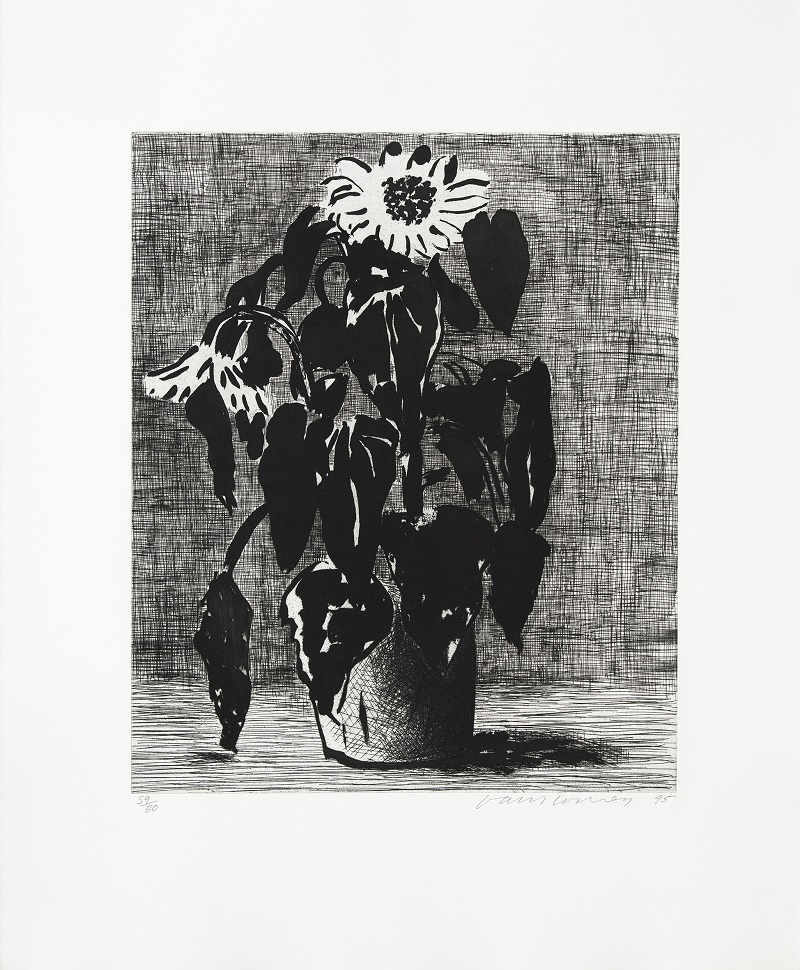
Sunflower power à la David Hockney

hockney sunflowerFor Flowers for Valentine’s, running through March 16 at the Galerie Catherine Putnam at 40, rue Quincampoix in Paris, Frédéric Poincelet has curated a group show including work by Marc Desgrandchamps, Blutch, Ugo Bienvenu, and, above, David Hockney, “Sunflower I” (347), 1995. Engraving, 80 ex./ Arches 69 x 57 cm. Copyright David Hockneystudio. Courtesy Galerie Lelong & Co.